Hyperland revisited







Published on 27 November 2025 by Andrew Owen (5 minutes)
Giving the keynote at the Embedded Systems Conference (ESC) in 2001, writer Douglas Adams said: “I may not have invented artificial intelligence, but maybe I can claim to be the father of artificial mendacity.” In the video game adaptation of his radio play, album, book, television series (and later film) The Hitchhiker’s Guide to the Galaxy, the computer lies to you. Like Wikipedia, the Guide is the product of carbon-based lifeforms and is not entirely unreliable. But why consult a guide when you can ask an agent? We’ll get to that.
Adams was speaking about the future shortly after losing his company (founded as The Digital Village and most notable for publishing Starship Titanic, novelized by Terry Jones) when the dot-com bubble burst. “It was based on the wonderful mathematical notion that if you multiply zero by a sufficiently large number, it’ll suddenly turn into something,” he said.
His point was that you can’t predict the future. But nonetheless, he predicted that the future would be dominated by technology, which: “as Danny Hill has pointed out, is our word for stuff that doesn’t work yet.” He also observed: “Only children understand the technology of their parents; they know how trivial it is because they weren’t around while we were struggling to invent it.”
Adams came up with a set of rules to describe our reaction to technology. Anything that’s:
He described Amazon as the least unsucessful retail site on the web. Why? “It’s built by the people who use it and shaped by how they use it,” he said. Unknowingly stumbling on the truth that the value in Amazon is created by its customers. He predicted that microtransactions would enable paid music streaming services to replace Napster and that along with newspapers compact discs and video, software would move online.
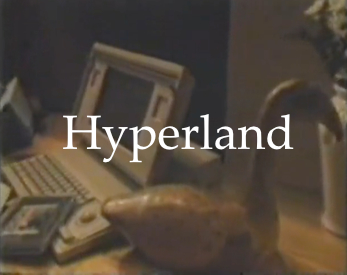
This wasn’t Adams’ first public attempt at predicting the future. That was his 1990 documentary “Hyperland”, widely acknowledged for prediciting the world wide web. But just as Steve Jobs missed Ethernet when he visited Xerox PARC, we all missed software agents when we watched Hyperland. And that’s particularly embarrassing when the software agent was played by former Doctor Who actor Tom Baker.
“I’m here to do your every slightest bidding. To fetch and carry for you. To work tirelessly and seflessly on your behalf. Always ready, always willing. No job too small or too menial… I’m a software agent. I am merely a simulacra. An artificial and completely customizable personality and I only exist as what we call an application in your computer. I have the honor to provide instant access to every peice of information stored digitally anywhere in the world. Any picture or film. Any sound. Any book. Any statistic. Any fact. Any connection between anything you care to think of, you have only to tell me and it will be my humble duty to find it for you and present it to you for your interactive pleasure.”—Tom
Adams nailed the functionality and obsequiousness of Chat-GPT 4. Early LLMs were text only, but interactive voice chat is widely supported. Video simulacra already exist in creepy AI girlfriend software and will probably cross over into mainstream AI applications before long. We all thought no one would want to make video calls when we saw “Back to the Future Part II”, and now we live on Zoom.
OpenAI now enables you to choose from a number of personalities:
We rapidly accept that the software agent is how we’re going to experience the documentary, and then we don’t think about it anymore. Life would surely mimic art in this respect if only we could get to the point where the agent would stop lying to us. This section of the documentary lasts for about six minutes and ends with the now familiar: “Sorry, the application agent has unexpectedly quit!” Blink and you’ll miss it, but Adams is using a touch interface, which we now take for granted.
The rest of the documentary covers topics including:
The credits include micons, the last of which is a cell phone. Micons are about the only thing Hyperland mentions that didn’t catch on. But some icons are animated (buffering, and so on) and others include real-time information such as the time, date or number of unread messages. It was an incredibly prescient documentary.
Sadly, most of the projects mentioned are no-longer easily accessible. CD-ROM software for outdated operating systems has gone the same way as the BBC Domesday Project (my first data entry gig). The one thing Hyperland failed to predict was digital obsolecense.
But to end on a happier note, we must return briefly to the ESC keynote. One of Adams’ compliants was the lack of a standardized power supply at the time. This is now mostly resolved by USB-C and EU common charger rules.